
Can happiness exist if you’re ambitious?
If you’re ambitious, chances are you’ve asked yourself this at least once.
“Am I actually happy… or will I be happy when I hit the next goal?”
We’ve all been there. I’ll be happy when I get the promotion. When the business settles. When the money worry disappears. When I’m fitter, freer, more successful.
The problem with this way of thinking is subtle but corrosive. It turns happiness into an output, a reward for effort, rather than something experienced along the way. And once happiness becomes conditional, it’s always just out of reach.
For ambitious people especially, this creates a life of perpetual “not quite yet.”
Because there is always another level.
Another role. Another salary band. A bigger house. A heavier lift. Another minute off the time.
All of these goals share a common thread. They’re external. They’re measurable. They’re visible. And when we attach happiness to external outcomes, they almost never deliver what we expect.
This is where many people conclude that ambition and happiness are in conflict, that you must sacrifice one for the other.
I see this even in the highly successful people who influence us, Steven Bartlett for example. No doubt there are elements to his work which light him up inside and he has wealth we would only wish for, but, is he happy? He’s built something extraordinary and has wealth most of us could only imagine, and he’s been strikingly open about the cost, the way the work eats into his health, his sleep, his diet and his time with the people he loves. Sacrifices he seems to accept as part of the journey of perceived success, even going so far to have quoted something along the lines of “I want to keep going just to be able to see how far I can push it”.
I admire that drive enormously. But it’s only one slice of the pie. Relentless push can build an empire and still leave the builder wondering, “am I happy now, or am I just betting on being happy one day?” That’s not a criticism of him, it’s the question every ambitious person should stop and ask themselves, because the answer is easy to keep deferring.
I very much hope he finds the balance where all things can align, but I digress.
When Work Pulls You Away From Yourself
One reason ambition feels incompatible with happiness is when “who you are” changes depending on “where you are“.
If the version of you at work feels different to the version of you at home, that internal friction builds quietly over time. You start telling yourself:
“This isn’t making me happy now, but once I’m through this phase, I will be.”
If your work:
- Bores you
- Requires behaviour you wouldn’t accept at home
- Forces relationships that feel inauthentic
- Is shaped by decisions that clash with your instincts or values
Then disengagement is almost inevitable. And in that state, ambition genuinely does feel like the enemy of happiness.
Alignment Is the Missing Piece
This is where the idea of alignment becomes important.
And this isn’t spiritual or abstract. It’s practical.
Alignment is when:
- What you’re working towards genuinely matters to you
- The work allows you to be the same person everywhere
- Your values don’t change depending on context
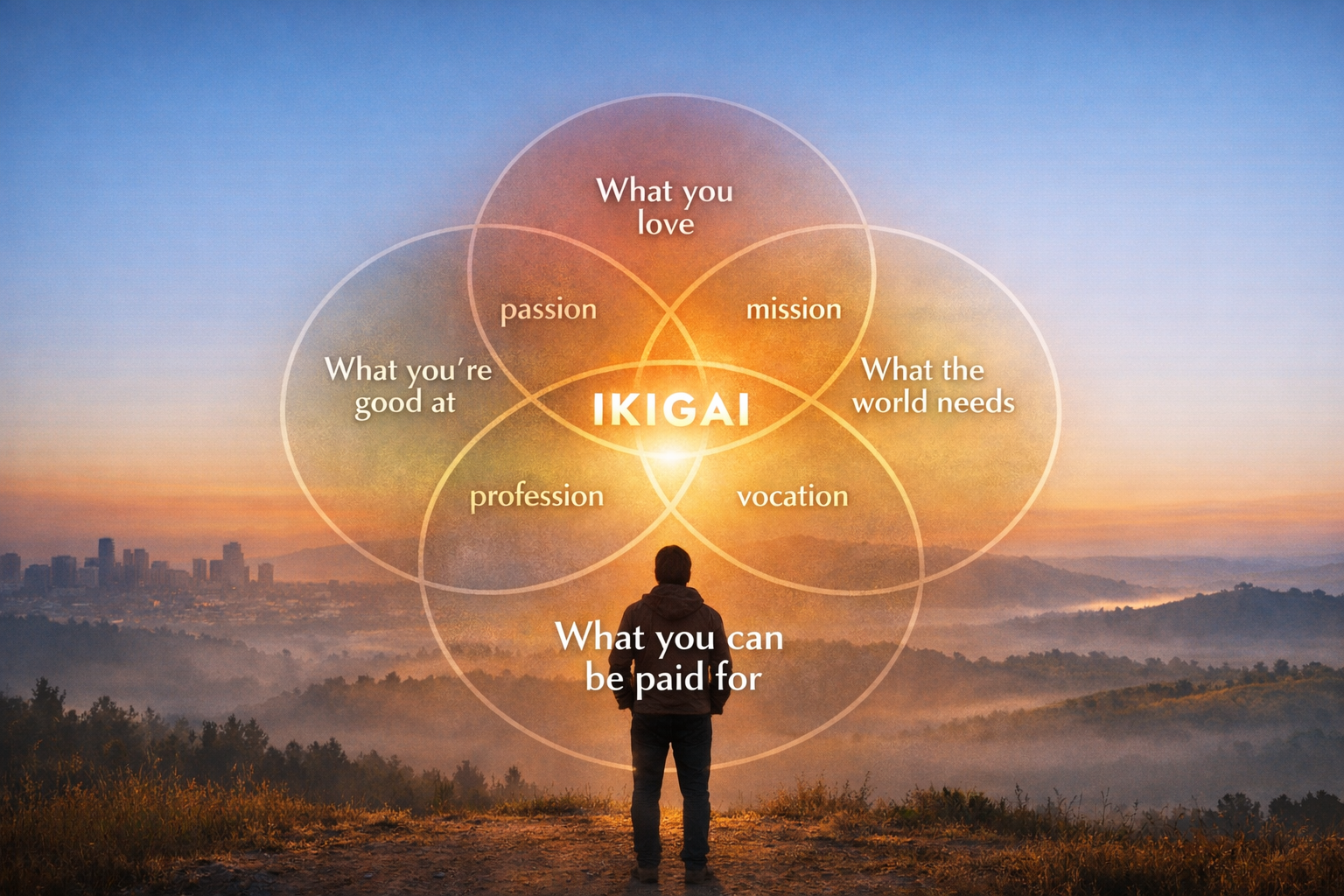
Interestingly, this is where the Japanese concept of Ikigai quietly comes into play.
I first heard of Ikigai when I was working with the JPIM – Japanese Institute of Plant Maintenance. (For those who don’t know, its a bit like the Oscars of manufacturing, very few businesses achieve the JIPM recognition). And the concept was recently brought up again with a senior leader who I respect massively.
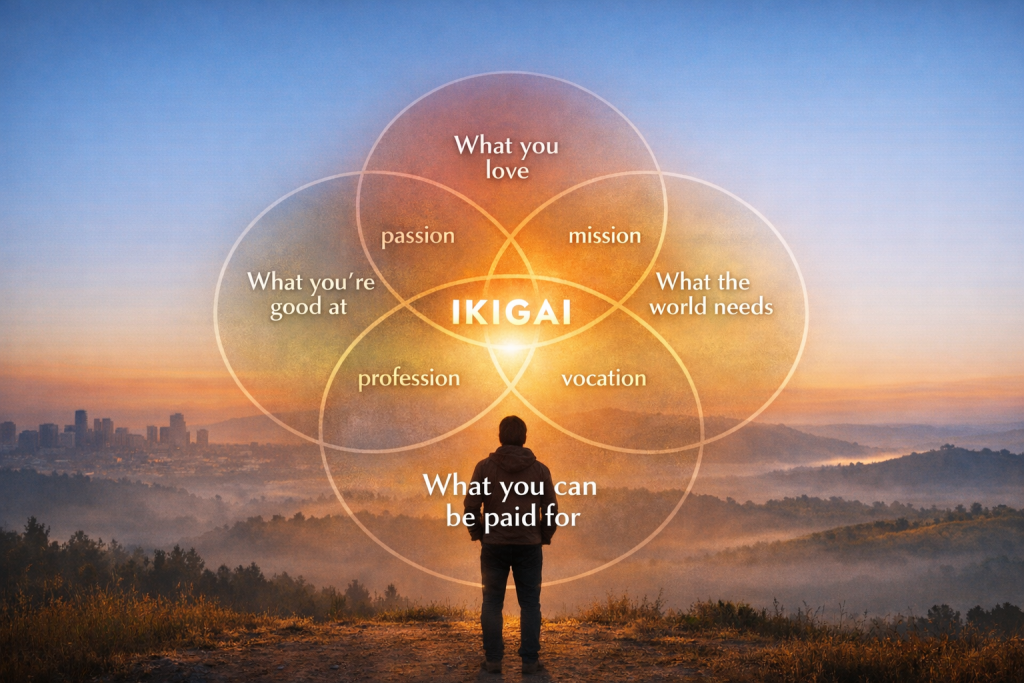
Ikigai is often oversimplified into a neat diagram, but at its heart it’s about something much more human: the intersection between what you enjoy, what you’re good at, what has value, and what gives your life meaning.
When work sits somewhere close to that intersection, ambition stops draining happiness and starts feeding it. Effort feels worthwhile. Energy is replenished rather than depleted. There’s a sense of fair exchange between what you give and what you get.
Many of us (myself included at times) follow a perceived path of success, hoping the outcomes will eventually buy us happiness. The paradox is that happiness rarely shows up if the work itself isn’t aligned with who we are.
Full disclaimer – I have worked for a long time doing something I am great at and has forged me a career that has supported my family, but, not necessarily brought me a great deal of joy. In this example, I sat squarely in the “profession” box. Feeling valued and contributing, but, missing my sense of purpose and feeling a little empty.
Why Goals Without Values Fall Flat
One of the most common mistakes people make is setting goals before understanding their values.
Ikigai doesn’t start with targets or titles. It starts with questions like:
- What do I care about?
- What engages me?
- What kind of person do I want to be?
- How do I want to contribute?
Without that clarity, ambition becomes blind. You can move fast, achieve a lot, and still feel strangely empty.
Boredom is often a clue. If you’re intrinsically interested in something, time behaves differently. Energy comes more naturally. That’s not accidental, it’s alignment nudging you.
The same applies to environments. Workplaces where you can speak honestly, act naturally, and feel psychologically safe are far more likely to align with your values than places where you’re constantly self-editing.
But alignment only works if you know your own values first.
Why “Successful” People Still Feel Unhappy
I’ve met many people who are incredibly successful on paper and quietly unhappy in reality.
They don’t worry about money. They have stable families. They take holidays without checking prices.
From the outside, it’s the dream.
Yet something feels off.
Often it’s because happiness has been externalised. It’s been made an outcome of ambition rather than something embedded in the work itself. Their goals look impressive, but they sit “outside” their personal Ikigai, disconnected from what genuinely gives them meaning.
Happiness at work often comes from “within”. From interest. From integrity. From being able to be yourself without friction.
The Courage Part
Once you understand your values, your drivers, and the kind of person you want to be, the next step is action. And that’s where courage comes in.
It takes guts to:
- Leave work that no longer fits
- Start something of your own
- Call out misalignment or poor behaviour
- Redefine success on your own terms
There’s always fear. There’s always risk. But the alternative is living in service of a future version of happiness that may never arrive.
So here’s the real question.
Would you rather not to be happy now, putting misplaced ambition in exchange for the hope of happiness later? Or would you rather be happy in what you do, so much so that you can’t tell where the work version of you ends and the home version begins?
Because joy doesn’t live at the finish line.
It lives in the journey. And we only get one.